
Table of Contents▼
Best Bets in Craps for Beginners – Strategy, Odds & Payouts
Best Bets in Craps for Beginners – Strategy, Odds & Payouts
Craps is one of the best deals in any casino – yet most beginners walk right past the table because it looks too complicated. It is not. We wrote this guide to break down every bet, payout, and strategy you actually need. Stick with us and you will play craps smarter than most people at the table.
What Is the Craps Table Layout?
The craps layout looks overwhelming, but it is organised into three zones. Once you see the pattern, most of the felt becomes noise you can ignore.
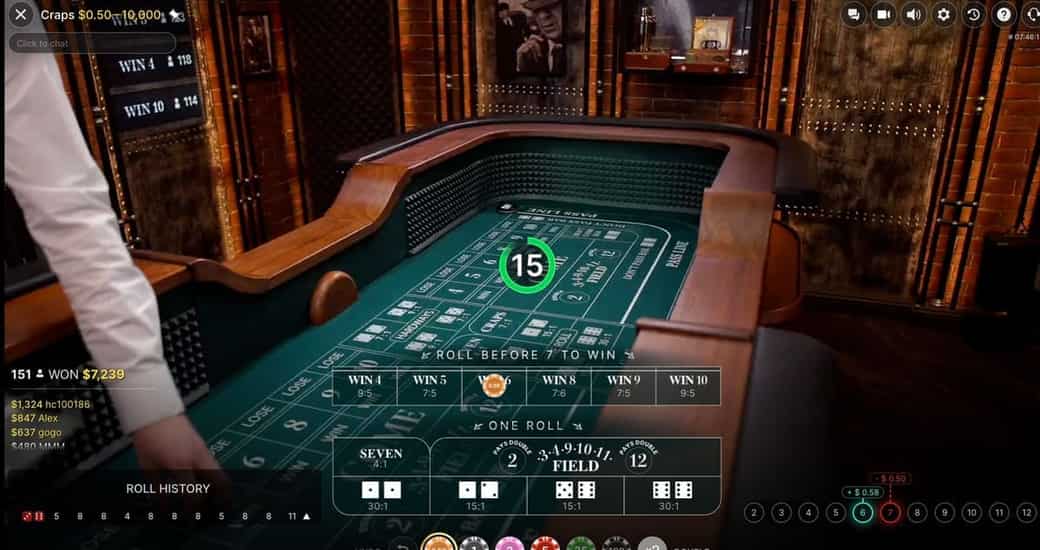
The pass line strip runs along the outer edge of the table. This is where the majority of players place their chips. Right above it sits the don't pass bar – same area, opposite bet.
The field and place-bet section occupies the middle band. You will see numbered boxes for 4, 5, 6, 8, 9, and 10 (place bets), plus the field bet area. These bets carry moderate house edges and appeal to intermediate players.
The proposition-bet centre sits in the middle of the table, shared between both sides. These are the flashy one-roll wagers – hardways, any 7, any craps – and they carry the highest house edges on the felt. As a beginner, pretend this zone does not exist.
Three casino staff manage the action: two base dealers handle chips on each side, a boxman supervises in the centre, and a stickman controls the dice and calls the rolls.
The craps layout shows every possible bet at once. Smart players focus on the pass line and odds bet along the outer edge – nothing else.
The Pass Line Bet – Your Starting Point
The pass line is the bread-and-butter craps bet. Place your chips on the "Pass Line" section before the come-out roll (the first roll of a new round).
How it works:
- Roll a 7 or 11 on the come-out? You win immediately
- Roll a 2, 3, or 12? You lose immediately (called "crapping out")
- Roll any other number (4, 5, 6, 8, 9, 10)? That number becomes the "point"
- The shooter keeps rolling. Hit the point again before rolling a 7 and you win. Roll a 7 first and you lose
The house edge on the pass line sits at 1.41%. That makes it one of the better bets in the building. It pays even money – bet $10, win $10.
This is the foundation of every sound craps betting strategy. Nearly every serious player starts here.
Always start at the pass line. It keeps you in sync with most other players at the table and carries a low house edge from the very first roll.
The Odds Bet – The Only Zero House Edge Bet in a Casino
After a point is set, the casino lets you place an additional bet behind your pass line wager. It is called the "odds bet" – and it is the single best bet in any casino.
The odds bet pays at true odds. No markup, no house edge. 0% house edge. Zero.
Craps Odds Payout Chart
Pass line odds payouts:
| Point | Odds Payout | True Probability |
|---|---|---|
| 4 or 10 | 2:1 | 33.3% |
| 5 or 9 | 3:2 | 40.0% |
| 6 or 8 | 6:5 | 45.5% |
Combined house edge at different odds multiples:
| Odds Multiple | Combined House Edge |
|---|---|
| 0x (no odds) | 1.41% |
| 1x | 0.85% |
| 2x | 0.61% |
| 3-4-5x | 0.37% |
| 10x | 0.18% |
| 100x | 0.02% |
Why would a casino offer a bet with no edge? Because you can only place it after making a pass line bet (which does carry a house edge). The casino makes money on the initial wager – the odds bet is a bonus for players who know to ask for it.
Most casinos cap odds at 3x, 4x, or 5x your pass line bet. Some offer 10x or even 100x. The higher the multiple, the lower the combined house edge drops.
The Don't Pass Bet – Betting Against the Shooter
The don't pass bet is the mirror image of the pass line. You win when the shooter loses (mostly). The house edge drops slightly to 1.36% – a tiny improvement over the pass line.
How it works:
- Come-out roll of 2 or 3? You win
- Come-out roll of 12? It is a push (tie)
- Come-out roll of 7 or 11? You lose
- A point is set? You win if a 7 comes before the point repeats
The math favours don't pass by a small margin. But there is a social cost. Other players bet the pass line and cheer together. A don't pass bettor wins when everyone else loses. If that does not bother you, the numbers are slightly in your favour.
You can also place lay odds behind a don't pass bet – the same 0% house edge deal, but payouts are inverted (you risk more to win less, since 7 is more likely than any single point number).
Come and Don't Come Bets
Come and don't come bets follow the exact same rules as pass and don't pass. The only difference: they are placed after a point is already set.
Think of a come bet as your own personal pass line. A new "mini-round" starts just for your bet:
- Come bet house edge: 1.41%
- Don't come bet house edge: 1.36%
You can also place odds behind come bets – the same 0% house edge deal. As a beginner, master the pass line and odds bet first. Come bets are the natural next step when you want more action at the table.
Place Bets vs Buy Bets – What Is the Difference?
Once a point is established, you can bet on specific numbers (4, 5, 6, 8, 9, or 10) to be rolled before a 7. There are two ways to do it: place bets and buy bets.
Place bets pay fixed odds set by the casino:
| Number | Place Payout | House Edge |
|---|---|---|
| 6 or 8 | 7:6 | 1.52% |
| 5 or 9 | 7:5 | 4.00% |
| 4 or 10 | 9:5 | 6.67% |
Buy bets pay true odds but charge a 5% commission (called the "vig"). For the 4 and 10, buy bets are better than place bets – especially at casinos that only collect the commission on winning bets.
The bottom line: place the 6 and 8 if you want extra numbers working. At 1.52%, they are nearly as good as the pass line. Avoid placing the 4 or 10 unless you are buying them.
Craps Bet Terminology – Yo, Horn & More
Craps has its own language. Here are the terms you will hear at the table (or see in the chat during live dealer games):
- Yo (Yo-leven): Dealer slang for 11. "Yo" avoids confusion with "seven" on a noisy table. The Yo bet is a single-roll proposition paying 15:1 with an 11.1% house edge
- Horn bet: A single-roll bet split across 2, 3, 11, and 12. Combined house edge around 12.5%
- Hardways: Betting that a number (4, 6, 8, or 10) will be rolled as a pair (2-2, 3-3, 4-4, 5-5) before a 7 or the "easy way." House edge: 9.1–11.1%
- Big 6 / Big 8: Even-money bet that 6 or 8 hits before 7. House edge: 9.1%. Never bet this – a place bet on 6 or 8 pays 7:6 at only 1.52%
- Any 7: Single-roll bet paying 4:1 that the next roll is a 7. House edge: 16.7% – the worst bet on the layout
- Any craps: Single-roll bet that the next roll is 2, 3, or 12. Pays 7:1 with an 11.1% house edge
Every term above is a bet you should avoid. We list them so you understand what is happening when the stickman calls them out.
Every Craps Bet Ranked by House Edge
Craps has more individual wagers than any other table game, and the spread between the best and worst is wider than in any other game in the building. Here is the whole layout in one table, ordered from the best bet in the casino to the worst thing you can put a chip on.
| Bet | House Edge | Verdict |
|---|---|---|
| Odds bet (behind pass or come) | 0.00% | The only true-odds bet in the casino |
| Pass line + 3-4-5x odds | 0.37% | The lowest combined edge available anywhere |
| Don't pass | 1.36% | Marginally better than pass, socially awkward |
| Don't come | 1.36% | Same math as don't pass, placed mid-round |
| Pass line (flat, no odds) | 1.41% | Fine on its own, wasteful without odds behind it |
| Come (flat, no odds) | 1.41% | Your own personal pass line |
| Place 6 or 8 | 1.52% | The only place bet worth making |
| Field (3:1 on the 12) | 2.78% | Acceptable only on this pay table |
| Place 5 or 9 | 4.00% | Skip |
| Field (2:1 on both 2 and 12) | 5.56% | The common version – skip |
| Place 4 or 10 | 6.67% | Buy them instead if you must |
| Big 6 / Big 8 | 9.09% | Never – place the 6 and 8 at 1.52% instead |
| Hardway 6 or 8 | 9.09% | Prop bet in disguise |
| Any craps | 11.11% | Skip |
| Yo (11) | 11.11% | Skip |
| Hardway 4 or 10 | 11.11% | Skip |
| Horn bet | ~12.50% | Four bad bets bundled into one |
| Any 7 | 16.67% | The worst bet on the main layout |
| Small / Tall (30:1) | 18.30% | Side bet – see below |
| All (150:1) | 20.61% | Side bet – see below |
| Fire Bet (999/249/24) | 20.76% | Side bet – see below |
| Fire Bet (2000/200/10) | 24.86% | The worst number on any craps felt |
Two things jump out. First, the top three rows are the entire strategy – everything below the place 6 and 8 is optional at best. Second, the field bet is the one wager whose edge depends entirely on the table: a field paying 3:1 on the 12 costs 2.78%, while the far more common 2:1-on-both version doubles that to 5.56%. Check the felt before you assume.
The gap between the best bet in craps (0% on the odds) and the worst (24.86% on some Fire Bet pay tables) is the widest spread of any casino game. Nothing else on the floor punishes bet selection this hard. The full cross-game picture is in our casino game odds comparison.
Bets to Avoid
The centre of the craps layout exists to take your money faster. Here are the worst offenders:
| Bet | House Edge |
|---|---|
| Proposition bets (any 7, any craps, hardways) | 9.1–16.7% |
| Big 6 / Big 8 | 9.1% |
| Field bet (most tables) | 5.6% |
| Horn bet | 12.5% |
Proposition bets sit in the centre of the layout. They resolve in a single roll and pay flashy odds – but the house edge is brutal. An "any 7" bet carries a 16.7% house edge. For comparison, the pass line is 1.41%.
Working vs Off – The Rule That Quietly Costs Beginners Money
This is the piece of craps nobody explains until it costs you a payout. Not every bet on the table is live on every roll, and the default settings are not the same for every wager.
- Pass line odds are always working. Once a point is set and you have odds behind your line bet, they stay live until the point resolves. You cannot turn them off, and you would not want to.
- Place bets are OFF on the come-out roll by default. If you have $30 on the 6 and the shooter throws a 6 on a come-out, you are not paid – the bet was not working. You can tell the dealer "my place bets are working on the come-out" to switch that on, but doing so also exposes them to a come-out 7.
- Come-bet odds are OFF on the come-out by default for the same reason. Your flat come bet stays live; only the odds behind it go dormant unless you call them working.
- Don't pass and don't come odds are always working. There is no off switch, because a come-out 7 is a losing roll for the darkside and the casino is not going to protect you from it.
The reason for the default is that a come-out 7 wins your pass line bet but would wipe every number you have working. The house turns them off so the two outcomes do not cancel each other out. Whether you leave them off is a genuine decision, not an oversight.
Craps Table Etiquette in 90 Seconds
Craps is the loudest, most physical game on the floor, and it comes with a short list of rules that are about procedure rather than politeness. Break one and the boxman will stop the game.
- One hand on the dice, always. Two hands raises the possibility of switching in loaded dice. It is the one rule dealers enforce with zero flexibility.
- The dice must hit the back wall. A throw that dies short gets called back. Aim for the far wall and let them bounce.
- Do not hand the dice back to the stickman. Set them down on the layout. Same reason as the one-hand rule.
- Keep your hands out of the roll zone. Once the stickman pushes the dice out, hands come off the table. A die that hits a hand is a dead roll, and the whole table will let you know.
- Cash goes on the layout, never into a dealer's hand. Put it down between rolls and say "change only." The dealer converts it to chips.
- You place some bets, the dealer places others. Pass line, don't pass, come, don't come, field and odds you position yourself. Place bets, hardways and props are called out verbally and set by the dealer – "place the six for ten."
- Late bets do not count. Once the stickman calls "no more bets," anything that lands is off for that roll.
None of this applies online, which is exactly why RNG and bubble craps are the right place to learn the flow before you stand at a live table.
Craps Strategy for Beginners
We can sum up the best mathematical craps strategy in one sentence:
Bet the pass line, then back it up with the maximum odds bet you can afford.
That combination gives you the lowest possible house edge in the casino – as low as 0.37% combined at tables offering 3-4-5x odds. No other table game gets that low without requiring advanced strategy. Among all casino games, craps with full odds offers some of the best player value. If you also play blackjack, a quick rule shift can swing the house edge in similar ways – the no-hole-card variant compounds losses on doubles and splits much like a misplayed prop bet does at craps. And if you drift over to the wheel between shooters, count the green pockets before you buy in – a single-zero table costs 2.70% against 5.26% on the double-zero version.
The $200 Session Bankroll Plan
Here is a concrete example of an easy craps strategy for a beginner session:
- Bankroll: $200
- Pass line bet: $5 (table minimum)
- Odds bet: $15 (3x odds)
- Total risk per round: $20
- Rounds before bankroll risk: roughly 10 full shooter cycles
- Expected mathematical loss over 50 rounds: about $1.50
That $200 bankroll gives you meaningful playing time while keeping the house edge razor-thin. At low-minimum online tables ($1–$2), a $50 bankroll works the same way.
5 Tips for Playing Craps
- Always take the maximum odds your bankroll allows. The odds bet is where the real value lives
- Ignore proposition bets entirely. No matter how exciting they sound, the math is terrible
- Start at low-minimum tables. Online craps tables start at $0.50–$5. Learn the flow before raising stakes
- Ask the dealer. Dealers expect questions from new players. They will walk you through placing bets – it is part of their job
- Set a stop-loss. Decide before you sit down: "I will walk away if my bankroll drops below $X." Then do it
Named Craps Strategies – 3 Point Molly & Iron Cross
Once you are comfortable with pass-line-plus-odds, two popular strategies add more action to the table.
The 3 Point Molly
The 3 Point Molly combines a pass line bet with two come bets – all backed by maximum odds. It gives you up to three numbers working simultaneously, each at the lowest house edge available.
How it works:
- Bet the pass line. A point is set
- Place a come bet. It travels to its own point number
- Place a second come bet. Now you have three numbers covered
- Back all three with maximum odds
The advantage: you have more numbers earning at 0% odds. The trade-off: you need a larger bankroll because three bets are active at once. A $5 base bet with 3x odds means $60 in play across three points.
This is the winning craps strategy for players who want more action without sacrificing the math.
The Iron Cross
The Iron Cross covers every number except 7 by combining place bets on 5, 6, and 8 with a field bet. You win on every single roll – unless the shooter rolls a 7.
It feels great when it works. The problem is the math: the combined house edge sits around 3.9%, which is significantly higher than pass-line-plus-odds. One 7-out wipes several rounds of small wins.
We would not recommend the Iron Cross as a primary strategy. But it is worth understanding because you will see other players use it, and now you know why the casino does not mind.
Playing Craps Online – Live Dealer, RNG & Bubble Craps
You do not need a Vegas trip to play craps. Online casinos offer three ways to roll the dice, and all of them use the exact same rules and odds.
RNG Craps
Standard online craps uses a random number generator. The table looks identical to a physical one, the bets are the same, and the house edges match. The advantage: table minimums start as low as $0.50, and you play at your own pace without a crowd. If you are exploring casinos in our rankings for craps, check the game filters for both RNG and live versions.
Live Dealer Craps
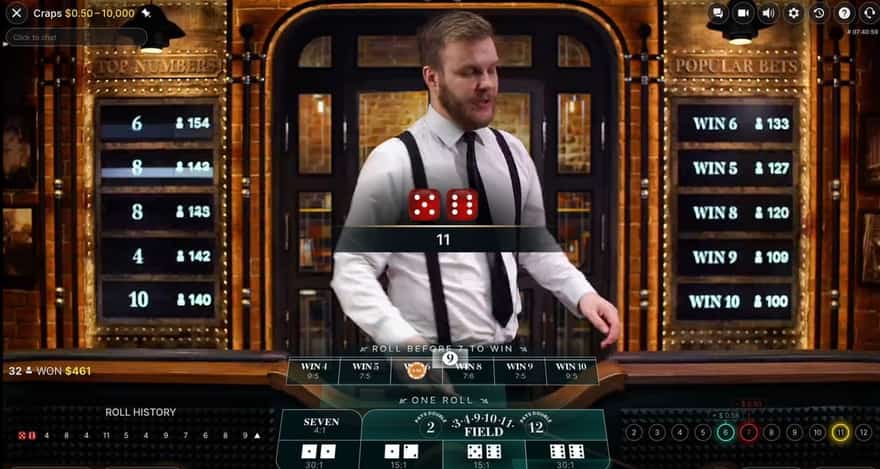
Live dealer craps streams a real table with a physical setup. You see the dealer, the dice, and the result in real time. The social element – chat, cheering – is surprisingly close to the real thing. Providers like Evolution Gaming offer polished live craps with side bets, statistics panels, and point tracking on screen.
Bubble Craps & Electronic Craps
Bubble craps (sometimes called electronic craps or stadium craps) is a single-player terminal found in land-based casinos. Physical dice tumble inside a sealed dome, or a certified RNG simulates the roll. The interface guides you through every bet.
Is bubble craps rigged? No. The machines use the same certified random number generators (or actual physical dice) as live tables, tested and audited by gaming commissions. The odds are identical. Your strategy does not change: stick to pass line plus odds.
Bubble craps terminals are popular because they remove the intimidation of a crowded table, offer lower minimums ($1–$3 is common), and let you learn the game at your own pace.
Live Craps Side Bets – The Fire Bet and All/Tall/Small
Open a live dealer craps table and the first thing the interface pushes at you is not the pass line. It is a pair of side bets with huge advertised payouts, sitting right where a beginner will tap them. Both are worth understanding precisely because they look like the exciting part.
The Fire Bet pays on how many unique points a single shooter makes before sevening out. Four different points typically pays 24:1, five pays 249:1, and all six pays 999:1. It is a genuinely thrilling bet to have live during a long roll. It is also a 20.76% house edge on that standard pay table, and some versions pay 2000/200/10 instead, which pushes the edge to 24.86% – the single worst number you will find on any craps felt.
All, Tall and Small (sometimes badged Bonus Craps) is the other one. Small wins if the shooter rolls every total from 2 to 6 before a 7; Tall needs every total from 8 to 12; All needs all ten. On the common 30:1 pay table, Small and Tall carry an 18.30% house edge, and All at 150:1 runs 20.61%. Some tables pay 34:1 on Small and Tall, which cuts the edge to 7.76% – still four times the pass line, but a different bet entirely. Check the payout before you assume.
Neither belongs in a strategy. Both belong in the same mental category as a lottery ticket: if you want one live during a hot roll, size it at a fraction of your line bet and treat the stake as spent. The full cross-game context for numbers like these is in our worst bets in the casino breakdown.
A $5 Fire Bet on every shooter costs more over a session than your entire pass line action. If you want the ticket, bet the table minimum on it once and put the rest behind your line.
What Is Crapless Craps?
Crapless craps is a variant where you cannot lose on the come-out roll. Numbers that would normally end the round instantly – 2, 3, 11, and 12 – become point numbers instead.
That sounds player-friendly. It is not.
In standard craps, the come-out roll is where you have a built-in advantage: you win on 7 or 11 (eight ways to win) and lose on 2, 3, or 12 (four ways to lose). Crapless craps removes that edge. You no longer win instantly on 11, and you no longer lose instantly on 2 or 3 – but losing the 11 hurts far more than gaining the 2 and 3 as point numbers.
| Variant | Pass Line House Edge |
|---|---|
| Standard craps | 1.41% |
| Crapless craps | 5.38% |
The odds bet is still available in crapless craps and still pays at true odds (0% house edge). So if you play crapless craps, take maximum odds to offset the higher base-bet edge. But given the choice, standard craps is always the better deal.
FAQ
What is the best bet in craps?
The odds bet – placed behind a pass line or come bet – has a 0% house edge. It pays true odds and is the single best wager available in any casino game.
What is the odds bet in craps and why is it free?
The odds bet is an additional wager you place after a point is set. It pays at true mathematical odds, so the casino has no built-in advantage. Casinos allow it because you must first make a pass line bet (which does carry a 1.41% edge) to qualify.
What is the house edge on the craps pass line?
The pass line carries a 1.41% house edge. Adding an odds bet behind it reduces the combined edge further – as low as 0.37% at tables offering 3-4-5x odds multiples.
Should I bet don't pass in craps?
Mathematically, yes – it has a slightly lower house edge of 1.36%. Socially, it depends on the table vibe. The savings are small, so go with whatever feels comfortable.
What are proposition bets in craps?
Proposition bets are one-roll wagers placed in the centre of the layout. They include bets like "any 7," "any craps," and hardways. They offer high payouts but carry house edges between 9% and 17%. Avoid them entirely.
Is online craps different from live craps?
The rules and odds are identical. Online craps uses a random number generator instead of physical dice. The table minimums are usually lower, and you can play at your own pace.
How much should I bet as a craps beginner?
Start at the table minimum. At most online casinos, that is $1–$5. Keep your pass line bet small so you can afford to place the maximum odds bet behind it – that is where the real value lives.
What is the best mathematical craps strategy?
Pass line plus maximum odds. At a 3-4-5x odds table, the combined house edge drops to 0.37%. The 3 Point Molly extends this by adding two come bets with odds, covering more numbers at the same low edge. No betting system or pattern can beat these numbers.
What does "Yo" mean in craps?
"Yo" is short for "Yo-leven" – dealer slang for 11. It avoids confusion with "seven" on a noisy craps table. The Yo bet itself is a one-roll proposition wager paying 15:1 with an 11.1% house edge. Know the term, skip the bet.
What is the difference between place bets and buy bets in craps?
Place bets pay fixed casino odds (e.g., 7:6 on the 6/8). Buy bets pay true odds but charge a 5% commission. For the 6 and 8, place bets are better (1.52% edge vs ~4.76%). For the 4 and 10, buy bets are better – especially if the casino only collects the commission on wins.
What is bubble craps and is it rigged?
Bubble craps is an electronic craps terminal where physical dice tumble inside a sealed dome, or a certified RNG simulates the roll. The odds are identical to a live table. It is not rigged – gaming commissions test and certify the machines. Strategy is the same: pass line plus odds.
How does crapless craps work?
A variant where 2, 3, 11, and 12 become point numbers instead of resolving immediately on the come-out roll. You cannot "crap out," but you also lose the instant win on 11 – which raises the pass line house edge from 1.41% to 5.38%. Odds bets are still available at 0% house edge, so take max odds if you play this variant.
How much should I bring to a craps session?
A $200 bankroll is a solid starting point for a $5-minimum table. Bet $5 on the pass line and take 3x odds ($15). That gives you roughly 10 full shooter cycles of play. At low-minimum online tables ($1–$2), $50–$100 works.
Are my place bets working on the come-out roll?
No – not by default. Place bets and the odds behind come bets are switched off on the come-out roll unless you tell the dealer otherwise. Your flat pass line, come, don't pass and don't come bets stay live, and pass line odds are always working. If you want your numbers live on the come-out, say "my place bets are working" before the shooter has the dice – but understand that a come-out 7 will then take them all.
What is the Fire Bet in craps and should I make it?
The Fire Bet pays on how many unique points one shooter makes before sevening out – typically 24:1 for four points, 249:1 for five, and 999:1 for all six. The house edge is 20.76% on that pay table and 24.86% on the 2000/200/10 version, which makes it the worst wager on the layout. Treat it as a lottery ticket at table minimum, never as part of a strategy.
What is the All, Tall and Small bet?
Three side bets, usually grouped as Bonus Craps. Small needs every total from 2 to 6 rolled before a 7, Tall needs every total from 8 to 12, and All needs all ten. At the common 30:1 payout on Small and Tall the house edge is 18.30%, and All at 150:1 runs 20.61%. A few tables pay 34:1 on Small and Tall, dropping the edge to 7.76% – so the payout printed on the felt changes the bet entirely.
Can I touch the dice with two hands in craps?
No. One hand only, every time, with no exceptions – it is the rule dealers enforce most strictly, because two hands creates an opportunity to switch in loaded dice. You also must not hand the dice back to the stickman; set them down on the layout instead. Neither rule applies to online or bubble craps, which is part of why they are the easier place to learn.
Does the field bet have a good house edge?
It depends entirely on the table. A field paying 3:1 on the 12 (or on the 2) carries a 2.78% house edge. The far more common version paying 2:1 on both the 2 and the 12 runs 5.56% – double the cost for an identical-looking bet. Check the printed payouts on the felt before you assume, and either way the pass line at 1.41% is the better home for the chip.