Casino apps vs mobile browser: Which is actually better?
"Download our app for the best experience" sits on every casino home screen. The pitch sounds obvious – a dedicated app must beat a browser tab. So is it true?
Not for most players. Casino apps and mobile browsers load the same HTML5 games with identical RTP – the app does not run a better version. A native app wins on biometric login, push alerts, and a marginal 5–10% faster launch, while the browser wins on zero storage, instant access, privacy, and always running the latest build. Many 'apps' are really PWAs (browser shortcuts), and app-store rules mean many casinos – especially crypto brands – have no native app at all.
Same games & RTP
Yes – identical HTML5
App speed edge
Marginal 5–10%
Best for an app
Loyal single-casino players
Best for browser
Multi-casino, low storage, privacy
KEY TAKEAWAYS
Most casino games are HTML5 and run identically in an app or a browser.
Many "casino apps" are PWAs – browser shortcuts, not native downloads.
Apps mostly win on biometric login – the real speed gain is a marginal 5–10%.
Browsers win on zero storage, instant access, discretion, and always-latest builds.
Only one path carries malware risk: third-party APK files from outside official stores.
We compared how casino apps and mobile sites are actually built in 2026, and the honest answer is messier than the marketing. Our honest take up front: most players overplay how much a casino app matters. The games are identical either way, the speed gap is marginal, and the downsides of stacking apps add up faster than the perks.
The truth most "app vs browser" articles skip
Modern slots and table games are built in HTML5. The same game file runs in Safari, in Chrome, and inside a casino app. The app does not load a special, smoother version of the game – it loads the same code in a wrapped window.
So when someone claims the app "plays better," what they usually mean is the app launches faster or feels tidier, not that the games perform differently. On a decent connection, a mobile browser runs the exact same titles at the exact same speed.
It reframes the whole question. You are not choosing between two versions of the casino. You are choosing between two ways to reach one casino.
In practice the speed gap is small. A native app shaves maybe 5–10% off launch and menu navigation thanks to cached assets – and nothing off the games themselves. Most players overplay it.
1 / 2
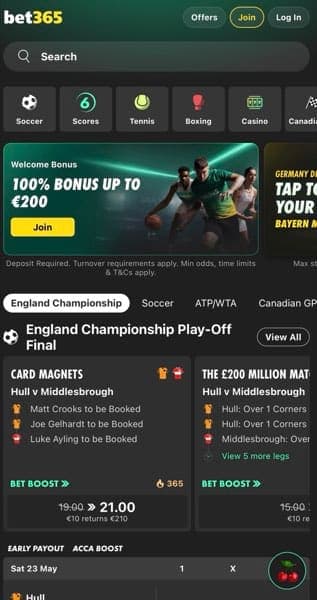
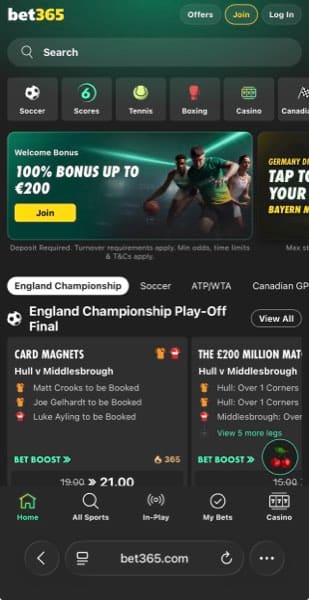
Same casino, two ways in: the bet365 native app (first) and the mobile browser (second). The only giveaway is the bet365.com address bar at the bottom of the browser version – the lobby, navigation, and games are identical.
Bottom line
The games are the same. The wrapper around them is what differs – and for many casinos there is no real wrapper at all.
What a casino "app" actually is
Three different things get called an "app," and the differences matter.
Native app. Built specifically for iOS or Android and downloaded from the App Store or Google Play. It can use device features like Face ID and push notifications. It also has to pass store review – which, for real-money gambling, is a high bar.
Progressive web app (PWA). The casino's website with an "add to home screen" option. It gets an icon and opens full-screen like an app, but it is still the site running in a browser engine. Most crypto casinos and many offshore brands ship a PWA, not a native app.
APK or third-party download. An Android install file offered directly from the casino's site, outside Google Play. It works, but it sits entirely outside store vetting – which is where the safety question starts.
If you tap "get the app" and end up adding a shortcut to your home screen, you installed a PWA. You are using the browser either way. It is not a downgrade – PWAs are genuinely capable – but it changes what "app benefits" really mean for you.
Where a native app genuinely wins
A true native app earns its place in a few clear scenarios:
Biometric login. Face ID or fingerprint sign-in is faster and safer than typing a password each visit. The verification logic behind it sits in the same KYC system we cover in our casino KYC guide.
Push notifications. Promo alerts arrive instantly. We are not sold on this one – constant pings are intrusive, and we would rather get offers by email, which is easy to mute, batch, and read on your own schedule.
Faster repeat launches. Cached assets mean the lobby opens quicker on the second and tenth visit.
App-only bonuses. Some operators dangle an exclusive offer to push the download.
The common thread: a native app pays off most for a loyal player who uses one casino several times a week. The convenience compounds.
Where the browser wins
For everyone else, the browser quietly wins on the things that actually annoy people:
Zero storage, and apps stack. One casino app runs 100–150 MB. That sounds fine until you keep 10–15 of them – with game-session data and cache piling on, the total climbs into several gigabytes. A browser costs nothing on disk no matter how many casinos you use.
Instant access to any casino. Open a tab and play. No download, no store search, no waiting on an install.
Always the latest version. The site updates server-side, so you never run an outdated build or chase an app update.
No library to manage. If you rotate between several casinos, browser play removes all the app clutter and the screen space it eats.
Discretion. No row of casino icons on your home screen. If anyone glances at or borrows your phone, a browser does not advertise that you play at five different casinos.
Heads up
If you play across several casinos or your phone is short on space, the browser is almost always the more practical choice.
The app-store problem: your casino may not have an app
Here is the factor the marketing never mentions: a native app might not exist for you at all.
Apple requires real-money gambling apps to hold a licence in each location they run, to be geo-restricted to those locations, and to be free. Google Play allows them only with a valid licence per country. Both stores reject or remove apps that fall outside those rules.
The result is a patchwork. A casino licensed for the UK might have a Google Play app there and nothing at all in another market. Crypto and offshore casinos, which rarely fit store licensing rules, mostly skip native apps entirely and ship a PWA instead. The exceptions come with caveats – V.Vegas offers an iOS app through the App Store, though it warns the name and icon may differ there. In the EU, the Digital Markets Act now allows sideloading and alternative app stores, which is slowly changing what is available – but for most players, "is there even an app?" is the first question, not "app or browser?"
If your casino has no native app, the choice makes itself: PWA or browser, both running the same site. The casinos we review note their mobile setup so you know before you sign up.
Safety: only one path can hurt you
Browser play and official app-store downloads are both safe. The risk lives in one specific place: third-party APK files.
Fake casino apps that mimic official stores are a documented scam – malware dressed up as a download, built to harvest logins or payment details. If you install an Android APK, take it only from the casino's official site, and never from a link in an email, ad, or message.
A browser sidesteps this entirely. There is nothing to install, so there is nothing to fake. If safety is your main concern and you are unsure about a download, the browser is the conservative pick. Our guide on how to choose an online casino covers the other trust signals worth checking.
Pro tip
Only ever download a casino app from the official App Store, Google Play, or a link on the casino's own verified site. An APK from anywhere else is not worth the risk.
Data, battery, and performance
Because the games are the same HTML5 code, data use and battery drain are broadly similar between app and browser. The heavy variable is not the wrapper – it is the game type.
Live-dealer tables stream real video and burn far more data than slots or RNG table games. That holds in an app and in a browser alike, and it is the real thing to plan around on mobile data. We break the numbers down in our guide on internet speed and data use for live casino.
An app can cache some interface assets, saving a little data over many repeat sessions. It is a marginal gain, not a deciding factor.
So which should you use?
The honest answer is contextual, so match it to how you actually play:
Loyal to one casino, play often, phone has space: install the native app (or PWA) for biometric login and instant launches.
Rotate between casinos, or play casually: stick with the browser. Less friction, nothing to maintain.
Short on storage or privacy-conscious: browser, every time.
Offered an APK from outside an official store: decline it and use the browser instead.
There is no universal winner, but the marketing tilts the scale unfairly. For most players an app is a nice-to-have, not an upgrade – the games are identical, the speed edge is a marginal 5–10%, and the storage, clutter, and privacy costs grow with every casino you add. Install one if you are loyal to a single site and want biometric login. Otherwise the browser is the cleaner default.
Either way, the casino itself matters more than the wrapper. Our best mobile casinos list ranks the operators that run cleanest on a phone – whether you reach them through an app or a browser tab.
Frequently asked questions
Are casino apps better than playing in a mobile browser?
Not universally. The games are identical HTML5 either way. Apps win on biometric login, push offers, and fast repeat launches; browsers win on zero storage, instant access, and always running the latest version.
Do casino apps and mobile browsers have the same games and RTP?
Yes. Both load the same HTML5 game files with the same RTP and RNG. The app does not run a different or better version of any game.
Is it safe to download a casino app?
From the official App Store or Google Play, yes. The risk is third-party APK files from outside official stores – fake casino apps are a known malware vector. Only download from verified sources.
Why doesn't my casino have an app?
App stores only allow licensed, geo-restricted real-money gambling apps. Many casinos – especially crypto and offshore brands – do not fit those rules, so they offer a progressive web app (PWA) you add to your home screen instead.
What is a casino PWA?
A progressive web app is the casino's website with an "add to home screen" option. It gets an icon and opens full-screen like an app, but runs in your browser engine. It needs no download and no app store.
Do casino apps take up a lot of storage?
One app runs around 100–150 MB, which seems minor. The problem is stacking – keep 10–15 casino apps with their cache and game-session data and the total reaches several gigabytes. A browser uses none of that space.
Do casino apps use less data than the browser?
Barely. Data use depends on the game, not the wrapper – live-dealer streaming is the heavy cost in both. An app caches some interface assets, which saves a little over many sessions.
Written by Nataly A, Casino reviewerWrites our casino reviews, guides and reports. Reads the terms, the cashier and the licence register so each page says what a casino actually offers.More from Nataly A
 By